
A pelvic floor chair quotation should tell you more than the price of a machine. You need to know what arrives, what your team needs before the first appointment, and what it costs to keep the equipment available. A lower purchase price can become a higher operating cost if training, replacement parts or repair transport are missing from the offer.
For professional buyers, pelvic floor chair cost includes the equipment package, delivery and setup, and ongoing service costs. This guide explains how to compare those costs, assess a Sunwinbeauty configuration and request a quotation that fits your business. It covers equipment purchasing, rather than the price a patient pays for pelvic floor care.
How much does a Sunwinbeauty pelvic floor chair cost?
The Sunwinbeauty EMS pelvic floor chair range is offered through individual quotations. The linked product page does not publish a fixed equipment price. Request a current base equipment price for your selected model, quantity and supplied configuration before building your budget.
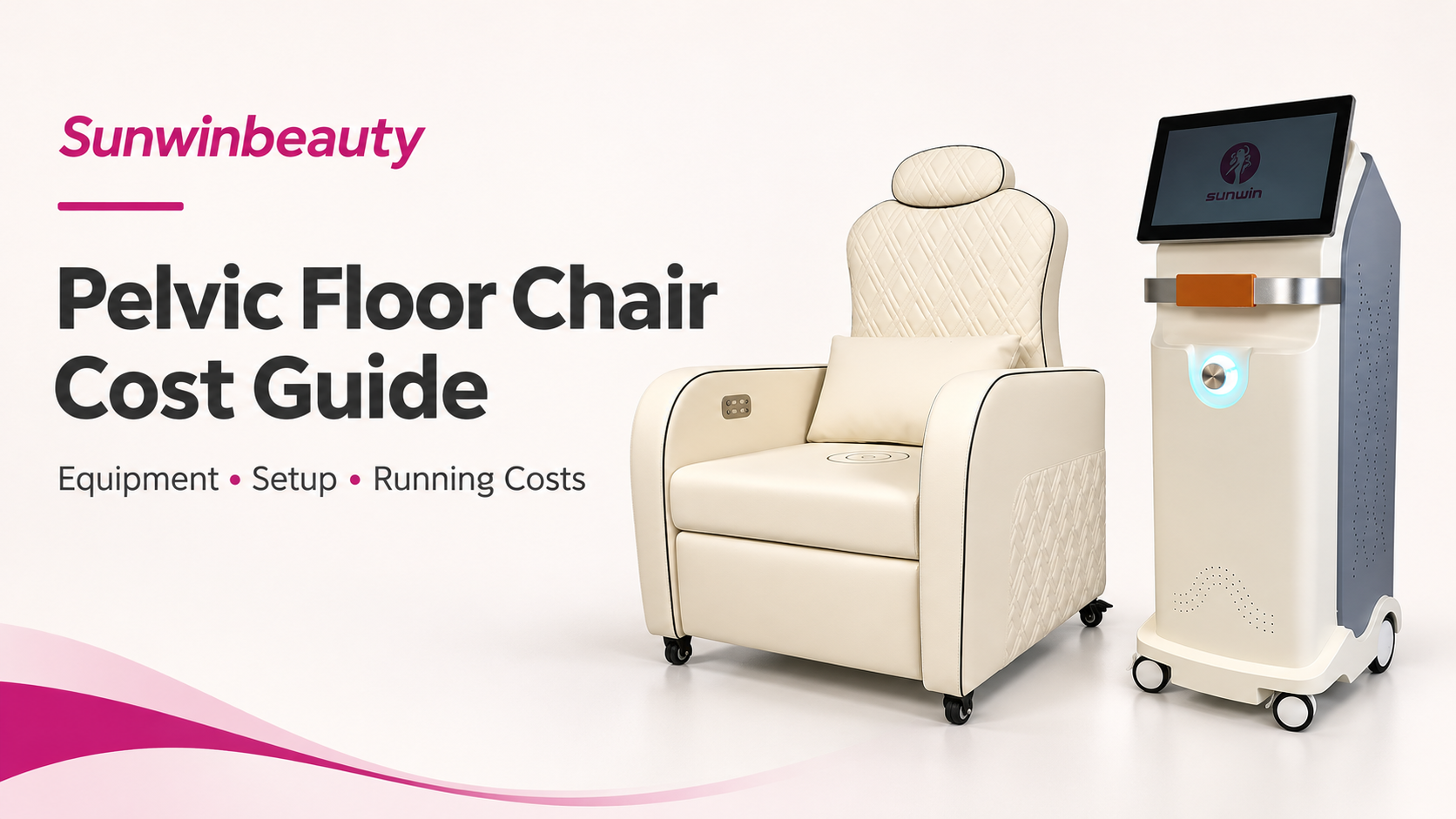
Start with the Sunwinbeauty electromagnetic pelvic floor chair if you are evaluating a seated system. Its product page describes electromagnetic stimulation, seated use while clothed and multiple waveform modes. Ask for the current specification sheet and operating manual to confirm the version offered. These catalog features describe the equipment; they do not establish clinical outcomes or suitability for an individual client.
Keep the quotation in three parts:
| Quotation section | What to ask the supplier to confirm |
|---|---|
| Base equipment | Exact model, main unit and chair arrangement, included components, power specification and price per unit. |
| Optional items and services | Available accessories, branding, interface languages, additional training and separately charged support. |
| Delivery and destination costs | Packing, freight and insurance where quoted, delivery term and named place, plus charges payable locally. |
Freight, insurance, import duties and taxes depend on the shipment and destination. Keep them separate from the base equipment price until the relevant details are available. This lets you compare equipment offers without presenting an incomplete figure as the total delivered cost.
Compare the technology and package behind the price
Product names containing “EMS” are not enough to establish that two offers are equivalent. Ask whether the quoted system uses electromagnetic stimulation or electrical stimulation delivered through electrodes, and request documentation for that specific device. Compare equipment with the same intended application and delivery mechanism before comparing prices.
For the Sunwinbeauty chair linked above, focus on the supplied configuration and the work needed to put it into service:
| Purchase check | Information to request | Why it affects the budget |
|---|---|---|
| System layout | A labeled photograph and packing list showing the chair, control unit and connecting components. | Helps identify missing items and plan installation. |
| Site requirements | Dimensions, weight, rated electrical input, access and clearance requirements. | Determines whether the delivery route and room are suitable. |
| Controls and documentation | Current manual, interface languages, adjustment controls and operating limits. | Affects staff preparation and handover. |
| Training | Delivery method, languages, covered tasks and any additional fees. | Staff time and refresher training belong in the budget. |
| Maintenance and service | Required inspections, serviceable parts, replacement costs and repair arrangements. | Helps estimate ongoing costs and possible downtime. |
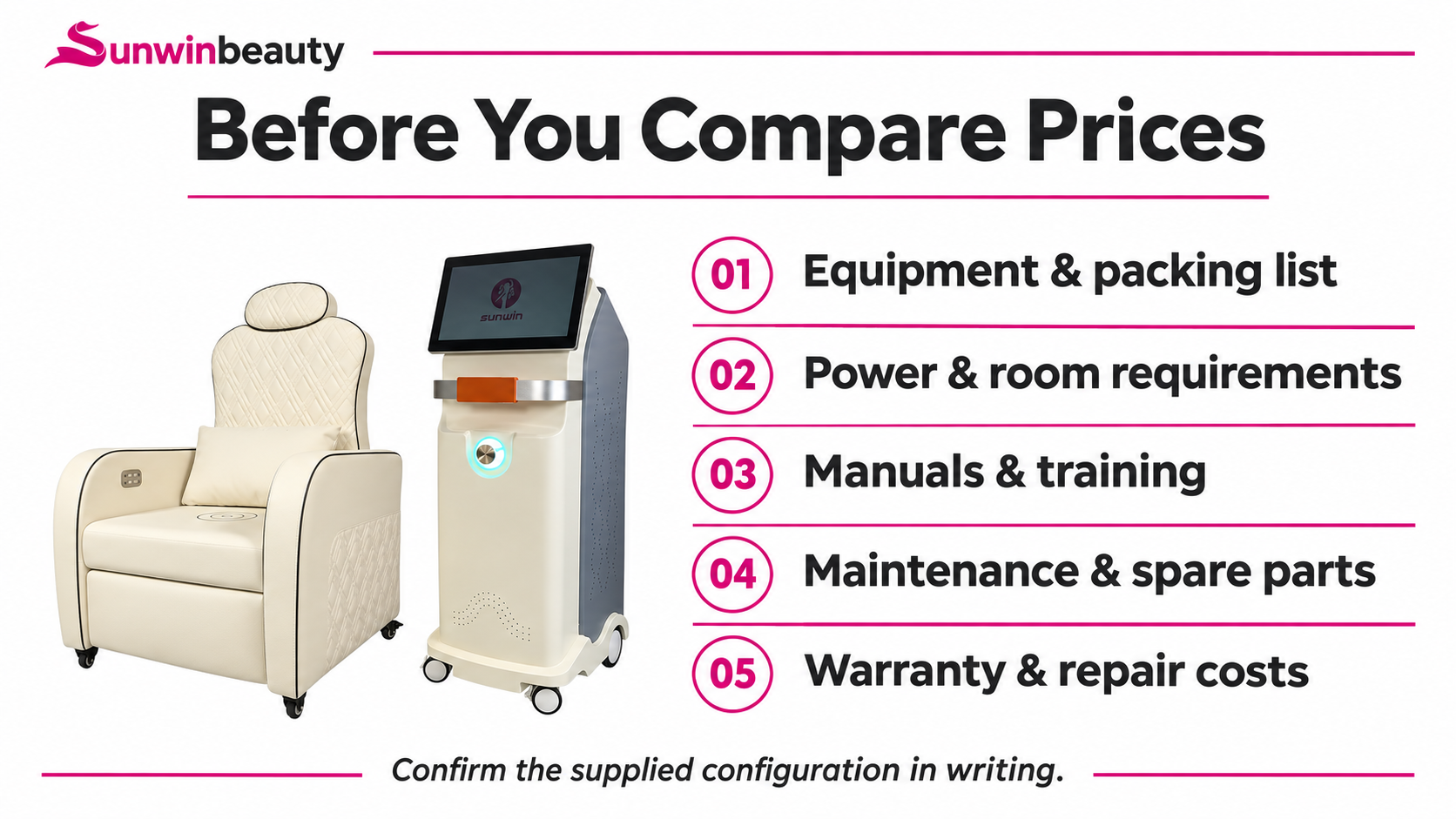
A higher advertised intensity or a longer mode list does not by itself establish better purchasing value. Ask how specifications are measured and which features matter to your planned workflow. Confirm the final package against the quotation before payment.
Check the intended use before investing in a service
A purchasing decision should connect the equipment’s documented intended use with your facility, staff and destination requirements. Request the current instructions, contraindications, operator requirements and relevant market documentation for the exact model. Equipment training and professional qualifications are separate requirements to evaluate.
Keep clinical evidence separate from catalog descriptions. For example, NICE guidance for women with stress or mixed urinary incontinence recommends supervised pelvic floor muscle training for at least three months as first-line treatment. That recommendation does not establish the effectiveness of a particular electromagnetic chair. A supplier’s contraction-count claim should not be presented as an equivalent number of voluntary exercises or as a guaranteed treatment result.
For the United States, the FDA explains that establishment registration and device listing do not establish approval or clearance. Check the exact manufacturer, model and intended use rather than relying on a certificate logo. Other destinations require their own assessment; a document for one market does not settle the requirements in another.
Budget for staff time, room use and maintenance
Do not assume that a chair with few routine accessories has no running costs. Ask for its consumable, cleaning, inspection and maintenance requirements, including whether any components have a service-life limit or paid replacement schedule.
Build the appointment cost around your full workflow: appropriate assessment and screening, preparation, equipment operation, cleaning and recordkeeping. A manufacturer’s operating-time figure is only part of the appointment slot. Use the manual and your facility’s approved procedures to determine actual scheduling.
Your budget should include:
- Operator and administrative time, plus professional assessment or supervision where required.
- Room preparation, privacy arrangements and the cost of occupying the space.
- Permitted cleaning supplies, routine maintenance and a repair reserve.
- Payment processing, booking costs and realistic customer acquisition expenses.
- Working capital for the period before appointment demand becomes consistent.
For an existing clinic, distinguish additional cash expenses from shared overhead and the value of room time. Avoid charging the same staff or room cost twice. Our pelvic floor program planning guide provides related workflow considerations to discuss with your team alongside the equipment budget.
Test the budget against completed appointments
Use completed, paid appointments to model operating performance. If you sell packages, use the net amount attributable to each delivered session after discounts and refunds. Receiving payment for a package does not remove the cost of providing the remaining visits.
Monthly operating cash contribution = completed paid sessions × (realized revenue per session − variable cash cost per session) − incremental monthly fixed cash costs.
The following example uses an initial project cash investment of USD 9,000, realized revenue of USD 80 per session, variable cash cost of USD 20 per session, and incremental fixed cash costs of USD 600 per month. All figures are hypothetical planning inputs, not Sunwinbeauty equipment prices, recommended treatment fees or customer results.
| Completed paid sessions per month | Monthly revenue | Variable and fixed cash costs | Operating cash contribution | Simple payback |
|---|---|---|---|---|
| 10 | USD 800 | USD 800 | USD 0 | No finite payback |
| 20 | USD 1,600 | USD 1,000 | USD 600 | 15.0 months |
| 40 | USD 3,200 | USD 1,400 | USD 1,800 | 5.0 months |
| 60 | USD 4,800 | USD 1,800 | USD 3,000 | 3.0 months |
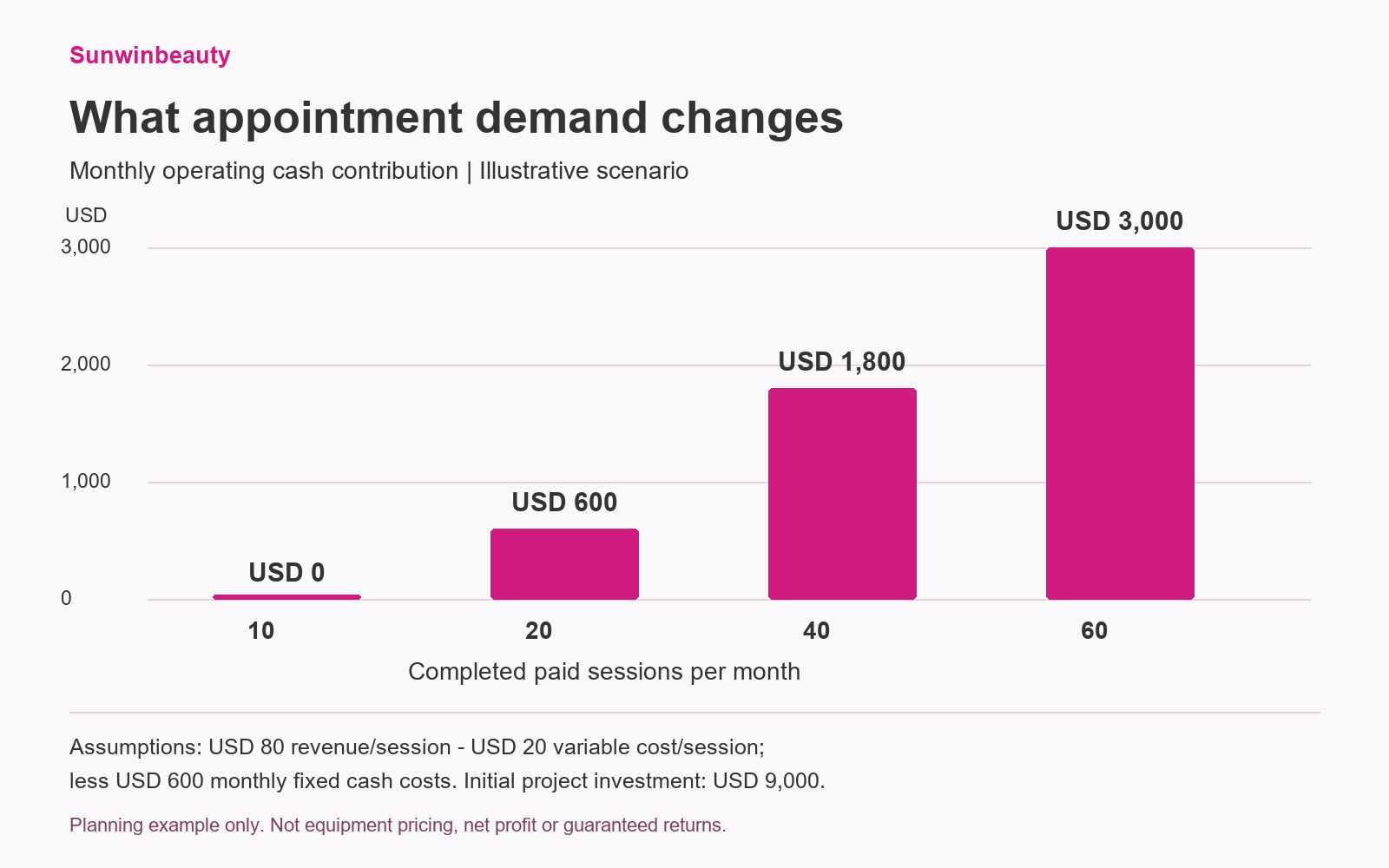
Simple payback divides initial project cash investment by positive monthly operating cash contribution. In this example, 10 sessions cover the stated monthly operating costs but recover none of the initial investment. The calculation assumes steady monthly activity and excludes financing, income tax, depreciation, residual value and launch-period ramp-up. It is not net profit or a guaranteed return.
Test a slower launch and lower realized prices before committing. At 20 sessions and USD 60 revenue per session, keeping the other assumptions unchanged, monthly contribution falls to USD 200 and simple payback extends to 45 months. This shows why the demand estimate deserves as much attention as the equipment discount.
Agree on repair responsibilities before delivery
A warranty duration alone does not explain how your business will receive support. Ask which components are covered, what is excluded, who diagnoses faults and where repairs take place. Clarify responsibility for parts, labor, transport and any import charges on replacement components.
For a clinic, establish a clear contact route and ask what records or fault information the support team needs. For a distributor, also define first-line local support, factory escalation, opening spare-parts requirements and training for the local service team. Request written lead-time estimates without assuming that every part will be available immediately.
If you need branding or other customization, include those requirements in your Sunwinbeauty OEM/ODM enquiry. Ask the team to confirm availability, minimum quantities, additional costs and delivery implications for the selected model.
Request a pelvic floor chair quotation for your business
A useful enquiry gives the supplier enough information to propose a defined package. Send your country and city or postal code, business type, intended service setting, preferred product, order quantity and target delivery date. Include interface-language, branding and local technical-support needs if relevant.
Ask for the base equipment price and packing list first, with optional items and delivery costs shown separately. Request the current manual, training scope, warranty terms and documents available for your destination. This gives your team a practical basis for comparing offers.
Request a Sunwinbeauty pelvic floor chair configuration and quotation. Clinics can include their planned staffing and appointment capacity; distributors can include opening-order quantity, demonstration-unit needs and local service arrangements.
Frequently asked purchasing questions
Is the equipment price the same as the total launch cost?
No. Delivery, import charges, room preparation, training and working capital may add to the equipment price. Confirm included items so that each cost appears once in your budget.
Does an electromagnetic pelvic floor chair replace physiotherapy?
A chair purchase does not replace professional assessment or establish a complete care pathway. Evaluate its documented intended use and relevant evidence with qualified professionals, and follow applicable local requirements.
Can I use another brand’s clinical results to promote this chair?
Do not present another model’s findings as outcomes for your equipment. Request evidence relevant to the named model and proposed use, and ensure your marketing claims match that evidence and local requirements.
What should a distributor request beyond the unit price?
Request quantity-based quotations, customization terms, demonstration-unit arrangements, documentation, training, spare-parts availability and the division of local and factory support responsibilities.
How quickly will the equipment pay for itself?
There is no fixed payback period. It depends on your initial investment, actual completed appointments, realized prices, operating costs and downtime. Replace the illustrative figures above with confirmed costs and a conservative demand estimate.


 EN
 ES
 AR
 FR
 JA
 DE
